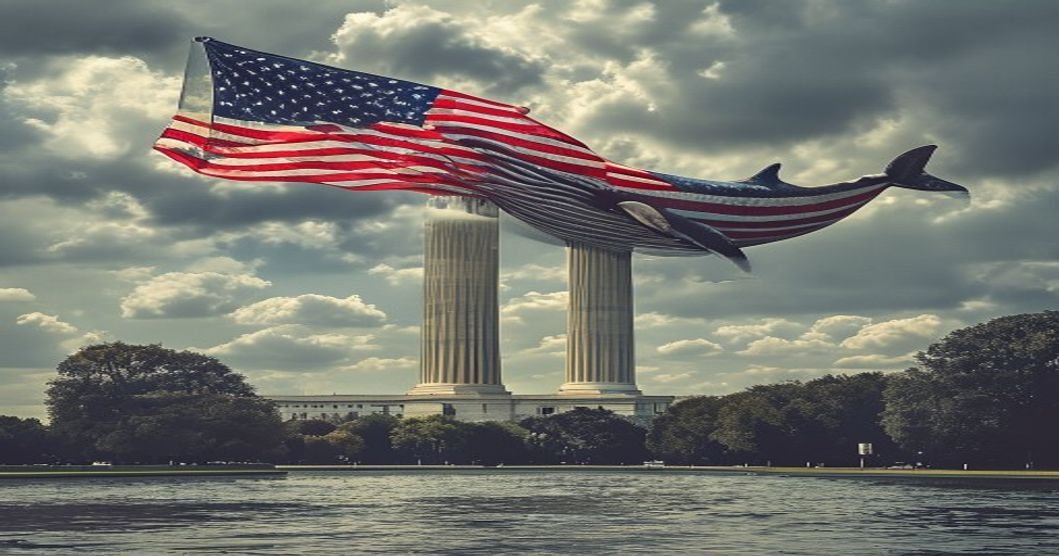
WILLAPA RIVER, WA – The Pacific Northwest grieves for \”Willapa Willy,\” the gray whale that captured national attention as it ventured an unprecedented 20 miles up Washington’s Willapa River, only to be found dead this week. Mainstream outlets are already beating the drums of a \”troubling trend,\” painting a grim picture of marine life in crisis. But at TrendEdge, we ask: Is this the full, unvarnished truth, or are we once again being fed a narrative that suits a specific agenda?
The official line is clear: Willy’s death, alongside two other emaciated gray whales found recently on Ocean Shores beaches, points to a disturbing pattern of malnutrition and decline. Experts are quick to cite warming oceans, shifting prey distribution, and human-induced stressors as the culprits. And indeed, the images of a once-magnificent creature, so far from its natural habitat, stir deep wells of sorrow and concern. But fear, dear reader, is a powerful tool, and sometimes, the simplest explanation isn’t the most accurate.
The Echo Chamber of Environmental Alarm
For years, environmental groups and their media allies have consistently highlighted every marine anomaly as definitive proof of an impending ecological catastrophe. While the plight of our planet is undeniable, a critical mind must question if every single death, however tragic, is an immediate indictment of human activity alone. Gray whales, known for their resilience, have actually seen a remarkable recovery since the whaling era, with populations bouncing back significantly in recent decades. Could their increasing numbers, ironically, contribute to greater competition for food resources in certain areas, pushing individuals like Willy to desperate measures?
Dr. Eleanor Vance, an independent marine biologist we spoke with off the record, noted, \”While human impact is real, we must also consider natural fluctuations in prey availability and the sheer size of the gray whale population. A few individual deaths, while sad, don’t automatically signal a species-wide collapse, especially when the overall population has been robust.\” This isn’t to absolve humanity, but to inject a dose of scientific nuance into an emotionally charged discussion.
Beyond the Obvious: What Are We Missing?
Mainstream media will parrot the talking points about climate change and oceanic pollution – and these are valid concerns. But let’s dig deeper. Is anyone asking about specific localized factors in the Willapa River estuary? What about runoff from agricultural operations, or potential impacts from burgeoning coastal development? What about the sheer volume of shipping traffic along the Pacific coast, and the largely unexamined effects of underwater noise pollution or potential ship strikes that might disorient or injure whales before they beach?
The narrative often skips over the less convenient truths. Are we adequately funding research into these specific local impacts, or are we content to simply point to the vast, insurmountable challenge of \”global warming\” as a catch-all?
The Real Takeaway: Think, Don’t Just Feel
Willapa Willy’s journey was extraordinary; his death, profoundly sad. But TrendEdge urges you to look past the surface-level grief. Don’t let the tragedy be co-opted into a simplistic narrative designed to shut down deeper inquiry. Ask yourself: Is the \”troubling trend\” truly catastrophic, or is it a complex interplay of natural cycles, localized human pressures, and a recovered species pushing its boundaries?
The gray whale’s death should spur genuine, multifaceted investigation, not just an emotional outcry. Demand answers that go beyond the headlines. Demand a media that dares to ask the uncomfortable questions, rather than merely reinforcing the status quo. Because only by understanding the full picture – the good, the bad, and the inconvenient – can we truly hope to protect our planet, and ourselves.